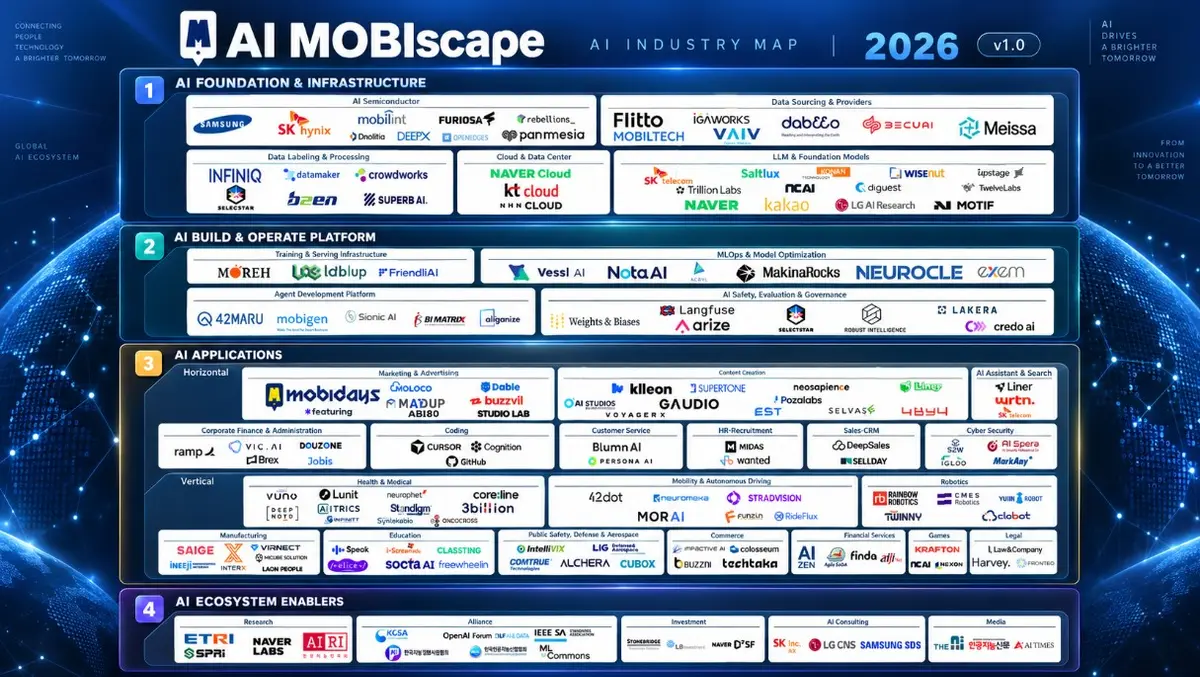
An AI industry map organized by role
Talk about AI usually starts with large language models and chips. But putting AI into production also requires data, stable deployment, and an understanding of industry workflows and regulation. To show that full picture, Korean ad-tech company Mobidays published AI MOBIscape 1.0, a Korean AI industry map covering more than 170 companies and institutions. Instead of listing names, it groups them by the role they play and the customer problem they solve.
Four roles
- AI Foundation & Infrastructure: chips, data, cloud and foundation models.
- AI Build & Operate Platform: training and serving, optimization, agent development, and safety and governance.
- Applications: horizontal tools used across industries, such as marketing and content production, and vertical tools for sectors like healthcare and manufacturing.
- AI Ecosystem Enablers: research institutes, associations, investors, consultancies and specialist media.
The structure reflects a practical problem: many companies build models, sell enterprise solutions and deliver integration work at the same time, so classifying by technology or industry alone hides how the ecosystem connects.
Companies cluster in applications
More than half of the companies on the map sit in horizontal or vertical applications. Content production and marketing and advertising firms stand out among horizontal players, as generative AI moves from producing text, images, video and audio into actual production workflows, and marketing uses expand into targeting, ad operations and performance analysis. Vertical players span healthcare, mobility, robotics, manufacturing and education — a sign that understanding industry data and workflows now matters more than raw model performance.
Mobidays stresses that the map isn’t a census of Korea’s AI industry but a curated view built from public information. Company counts signal where attention is focused, not market size.
The next contest: operating AI
As applications multiply, the operational layer beneath them grows in importance. Demoing an AI service once is different from running it in customer workflows every day. Teams must choose among models, manage cost and latency, catch wrong answers and data leaks, and keep compliant records. That’s the job of training and serving infrastructure, MLOps and model optimization, agent development platforms, and AI safety, evaluation and governance.
Once AI agents connect tools and internal data to act on their own, controllability matters as much as development speed: what data the agent accessed, why it produced a result and where it can be stopped. It’s why AI features keep getting shipped and pulled without guardrails.
How marketers can use the map
Marketing and advertising AI is the most crowded category. When evaluating vendors, ask operational questions before comparing feature lists: which models they use and how costs change, how much access they need to ad accounts and customer data, and whether actions are logged and reversible. As with the approval tiers in artist-supervised AI marketing agents, controllable tools are the ones you can keep using.
Mobidays plans to update the map continuously and accepts corrections. Sparse areas aren’t automatically promising markets, but the map is a useful prompt for asking where bottlenecks will appear as adoption grows.