Korea's coffee franchise market keeps growing, but the numbers tell a story of increasingly saturated competition. According to the Fair Trade Commission's 2025 franchise industry statistics, Korea now counts 13,725 franchise brands and 379,739 stores overall. Within coffee specifically, there are 921 brands and 29,101 stores — an average of roughly 31 stores per brand.
More stores doesn't mean more revenue
Ranked by store count, the leaders are Mega MGC Coffee (3,325), Compose Coffee (2,649), Ediya Coffee (2,562), Paik's Coffee (1,712), and A Twosome Place (1,510) — large, budget-oriented chains driving the store-count race.
But rank by average annual revenue per store and the leaderboard flips. A Twosome Place tops the list at KRW 571 million, followed by About Coffee (KRW 445 million), Plus82 (KRW 423 million), Pascucci (KRW 403 million), and Baekeok Coffee (KRW 392 million). More locations clearly doesn't translate to higher per-store revenue — scale and profitability don't automatically move together.
The shift toward profit-first decision-making
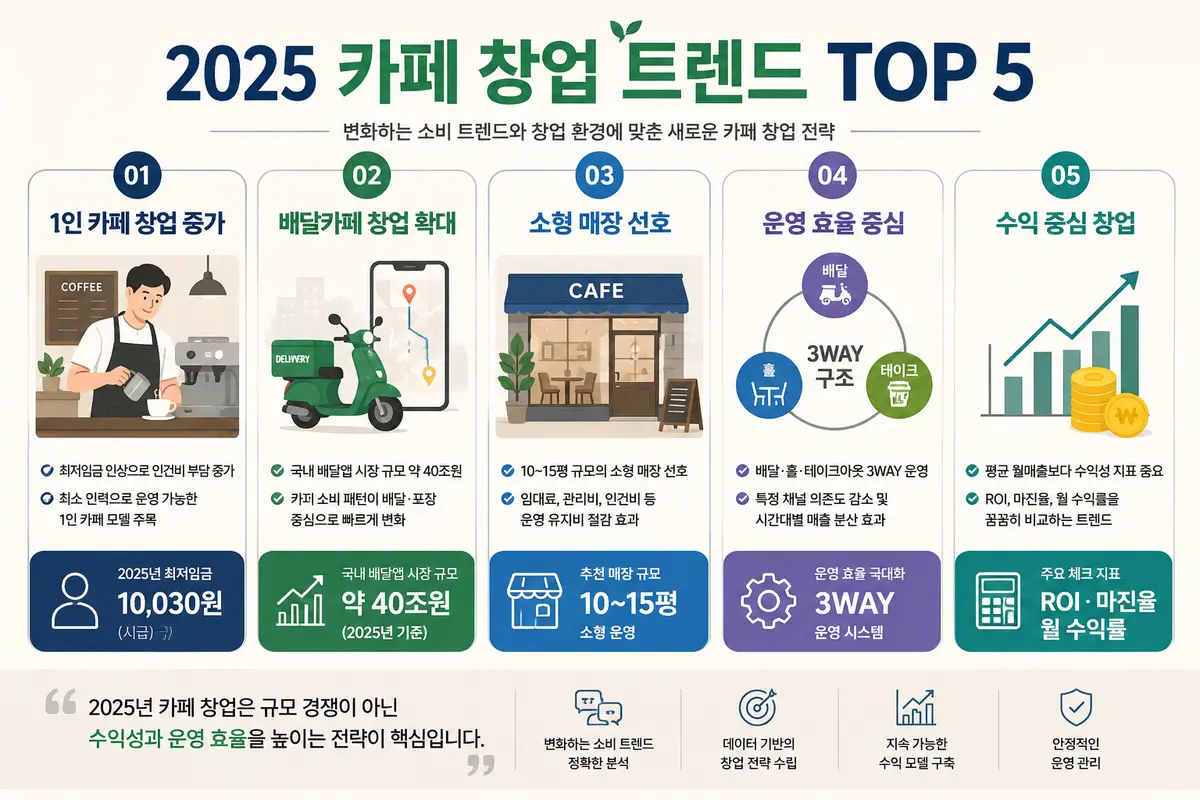
The report points to five emerging trends in coffee startups: rising minimum wage (KRW 10,030/hour in 2025) pushing more owners toward solo-operator cafes to cut labor costs; growth in delivery-focused cafes targeting a roughly KRW 40 trillion delivery-app market; a preference for small, 10–15-pyeong stores; a "3WAY" operating model covering delivery, dine-in, and takeout; and a stronger tendency to compare real profitability metrics — ROI, average margin, monthly return — before committing to a franchise.
Because of this, the report stresses evaluating not just startup cost but expected fixed costs, margin structure, and payback period — since actual profitability swings widely based on location, rent, labor, delivery share, staffing, store size, and promotions.
What this means for marketers
The core shift this report reveals is that competition in the coffee franchise market is moving from brand scale to investment efficiency and profitability. Prospective franchisees are basing decisions on data-driven investment efficiency rather than simple brand awareness — which means franchisors' marketing messages need to shift accordingly.
A "we opened X stores" scale metric alone is no longer persuasive. Leading with transparent profitability data — per-store revenue, ROI, payback period — is becoming a stronger differentiator. In a market restructuring around small-format, delivery-first stores, content that proves operating efficiency with concrete numbers is increasingly what decides a prospective franchisee's choice. The shift from awareness advertising to data-driven trust marketing is now a category-wide task in coffee franchising. If your brand needs to build this kind of data-backed franchise marketing content, Best Partner's services can help.