Where company time really leaks
The biggest time sink at work isn’t meetings or reports — it’s hunting for things: last month’s final contract, why a feature was built a certain way, who owns an advertiser. The information exists; it’s scattered across Slack, Confluence and GitHub, and only certain people know where. When they go on vacation or leave, the company’s search function leaves with them. A 2023 Forrester study commissioned by Airtable found knowledge workers spend about 30% of their time finding data, and large enterprises use 367 software apps on average.
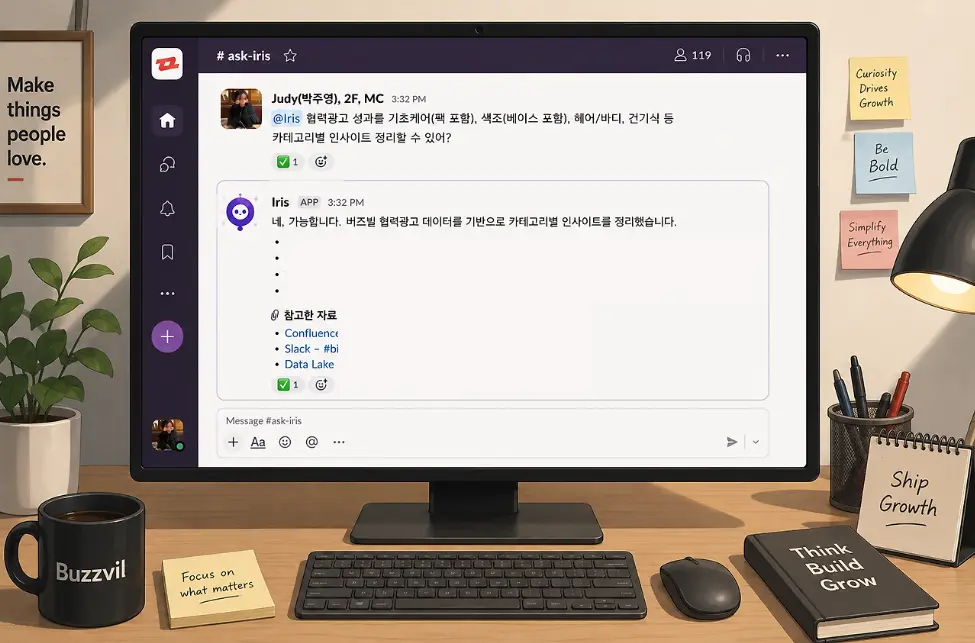
Korean ad-tech company Buzzvil has a colleague that handles these questions: Iris, an internal knowledge agent working in a public Slack channel since June 2026. It’s a useful case for any team weighing an internal AI agent.
What Iris does — and doesn’t
When a new salesperson asks what a retail partnership ad program is and where its policies live, Iris answers and attaches source links, replying in the language of the question. It moves across Slack, GitHub, Linear, Confluence, ad, settlement and sales data and org information to assemble one answer. It doesn’t connect everything; deciding what not to connect is part of the design.
Iris doesn’t do the work. It retrieves the company’s scattered memory with sources; people decide what to do with it. What changes is density, not just speed: the first ten minutes of meetings once spent finding materials now happen in the channel beforehand, so meetings start at “go or no go.”
Structured data, not the model, makes it work
Buzzvil’s decade of Slack messages, pull requests, code reviews, retrospectives and advertiser history totals only about 200GB. Volume wasn’t the issue. What matters is that each piece of data carries metadata — what it’s about, what it connects to, when it was last updated — enabling cross-verification: GitHub for what was built, Slack and Confluence for why, the org chart for who owns it, the data lake for numbers. Instead of having the agent query each system on demand, Buzzvil turned the data into files the agent reads directly.
Four decisions before choosing a model
- What to connect: decisions live in Slack, rationale in GitHub, owners in the org chart; one source gives half an answer. Decide what not to connect, too.
- Whether every answer cites sources: sources let people verify instantly. Adoption depends on verifiability, not the model.
- How it expresses what it doesn’t know: Iris says up front that it can’t search the internet or view images. One plausible wrong answer is remembered longer than ten right ones.
- Where it’s used: a public channel, not DMs. Answers persist for the next person, and mistakes get corrected quickly.
Start small and share it
Iris began as a CTO’s proof of concept — no budget approval, no roadmap. In a recent week, more than 100 employees asked it questions, and 57.6% weren’t developers: sales, business development, customer experience, planning, marketing and media operations. It has become the company’s shared search box.
Implications for marketing teams
Campaign history, advertiser performance and brand guidelines often live in people’s heads and scattered docs. Structure that memory and make it retrievable with sources before debating models. The problem of employees hiding their AI use eases when knowledge flows in public, and managing shared prompts ties into who owns the AI prompts employees write. Internal agents change not how fast a company searches, but how it remembers.