OpenAI's self-serve ad platform opened to everyone in May 2026. ChatGPT Ads lets advertisers target conversations relevant to their products and promote a brand at the moment of interest — similar to Google Search ads in intent, quite different in operation.
Who you can reach
Ads serve only to users OpenAI believes are 18 or older on the Free and Go tiers, including logged-out sessions. If your audience mostly pays for higher tiers, reach will be hard. If you are looking for people using the tool cheaply or free, it may fit.
What it costs
Average CPCs land in the $2–$5 range across industries. Set a max CPC below $3 and the platform warns your ad may not deliver — apparently a hard-coded threshold rather than a dynamic assessment of competition or creative quality.
Step 1: Confirm eligibility
Restricted categories
OpenAI restricts advertising in categories including adult content, alcohol, tobacco, financial services, and gambling. Some policies are self-contradictory: the policy page says ads for legal advice, representation, or legal services are not permitted, while the changelog says some legal ads are allowed. Lawyer ads have been running since at least May 2026.
Budget and geography
Daily budgets start at $25, down from the $200,000 minimum commitments required during the pilot. Targetable countries: the United States, Australia, Canada, Japan, New Zealand, South Korea, and the United Kingdom.
Step 2: Set up the account
Collect first: legal business name, business tax ID, payment method, and a favicon. Create the account at ads.openai.com.
OpenAI says agencies should not create accounts on behalf of clients — advertisers add agencies as users instead. There is no equivalent to Google Ads Manager Accounts or Meta Business Manager yet. A single user can access multiple ChatGPT Ads accounts, but there is no known way for one user to create multiple accounts.
Step 3: Campaign structure
The hierarchy is familiar: Campaign > Ad group > Ad.
Campaign: type (standard or product feed), objective (Reach, Clicks, Conversions), locations to target or exclude (country, region, DMA, postal code), custom audiences (first-party upload), budget (daily or total), conversion event (optional), start and end dates.
Ad group: bid, default ad destination URL, context hints.
Ad: destination URL, headline (50-character max, can truncate), description (100-character max, can truncate), image (PNG or JPG, square, at least 256 × 256 px).
Bidding and the auction
Bid for Clicks, Reach, or Conversions. Most start with Clicks — set a max bid like Google's Manual CPC and pay per click. Reach charges per 1,000 impressions. With the OpenAI pixel installed you can optimize toward conversions, but billing stays per click with a bid cap.
OpenAI uses a "relevance-weighted, second-price auction to select among eligible ads," structurally similar to Google's Ad Rank. Multiple ads serving at once has also been reported.
Step 4: Targeting — there are no keywords
This is the biggest adjustment coming from Google or Meta. No keywords, no demographics, no in-market audiences. Apart from geography, first-party data, and the wording of your ad and landing page, the primary control is context hints at the ad group level.
OpenAI's guidance: "Describe the conversations, topics, or keywords where your products or services may be relevant; these hints guide matching but aren't exact-match targeting rules."
You can leave it blank, dump keywords in it, or write a carefully crafted prompt. This field is ripe for testing.
Case study: keyword list vs. full questions
Two ad groups in one campaign — a "Keywords" group with a Google-style keyword list, a "Conversational" group with full questions people might ask ChatGPT — with identical ad content.
In this test, the Keywords group served far more often, with a slightly higher CTR and a lower average CPC.
Keywords: "Lumber yard near me," "Buy 2x4s," "Cedar planks for decking."
Questions: "Where is the closest lumberyard?," "What is the most cost-effective material to use for decking?," "How long do cedar decks last?"
Conversational hint: "I want to target DIY homeowners in the San Antonio, Texas area who are looking for a source for high-quality cedar planks to use for decking projects."
First-party data
You can target or exclude audiences built from customer emails and phone numbers, but the 25,000 matched-user minimum rules this out for most SMBs.
Step 5: Build the ads
Ads appear at the bottom of a conversation labeled "Sponsored," in static and product formats.
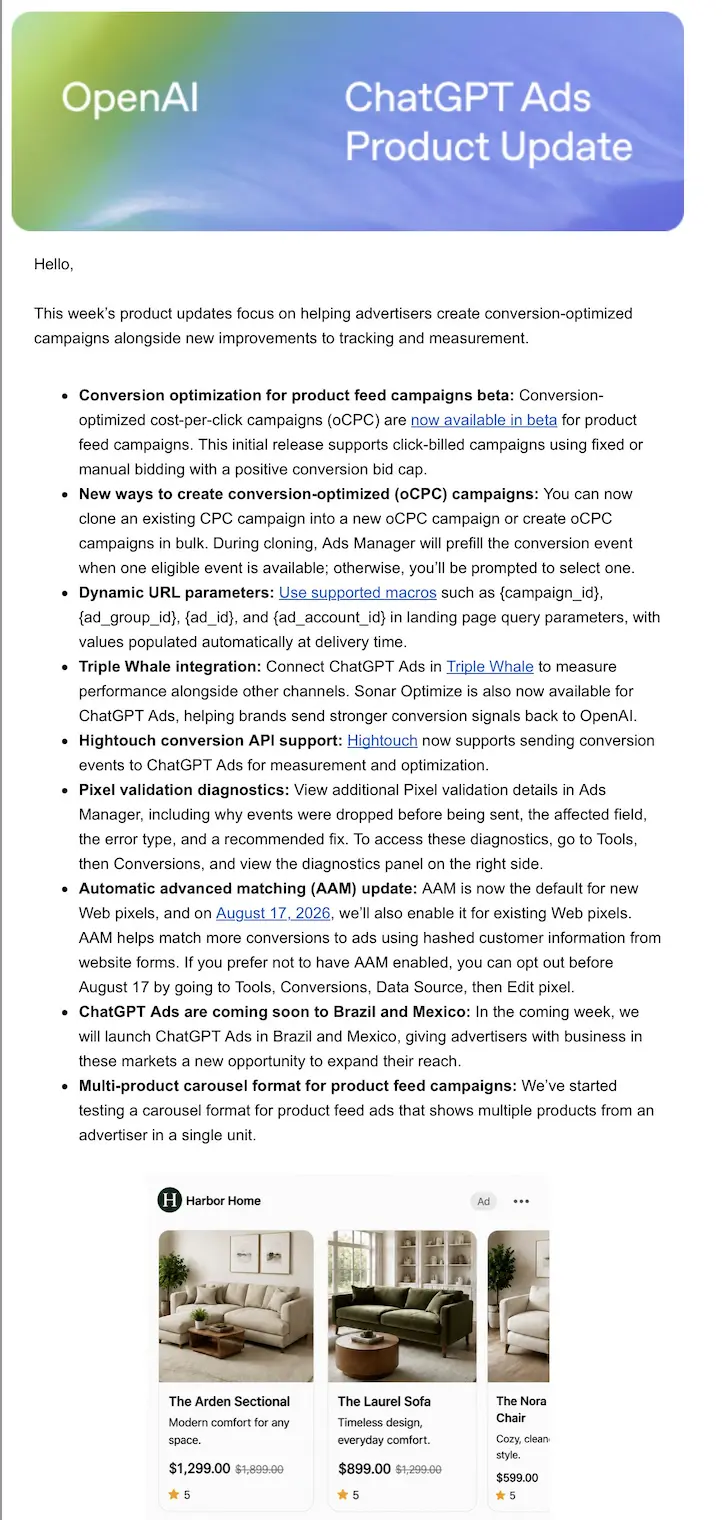
Product ads run off a submitted product feed. They initially looked identical to static ads, but OpenAI announced on July 24 that the product card format would show prices and star ratings. The feed submission process is currently clunky and glitch-prone.
Step 6: Set up measurement before launch
OpenAI's pixel works much like the Google and Meta pixels — install base code, fire events on button clicks or page loads, set dynamic values like order revenue.
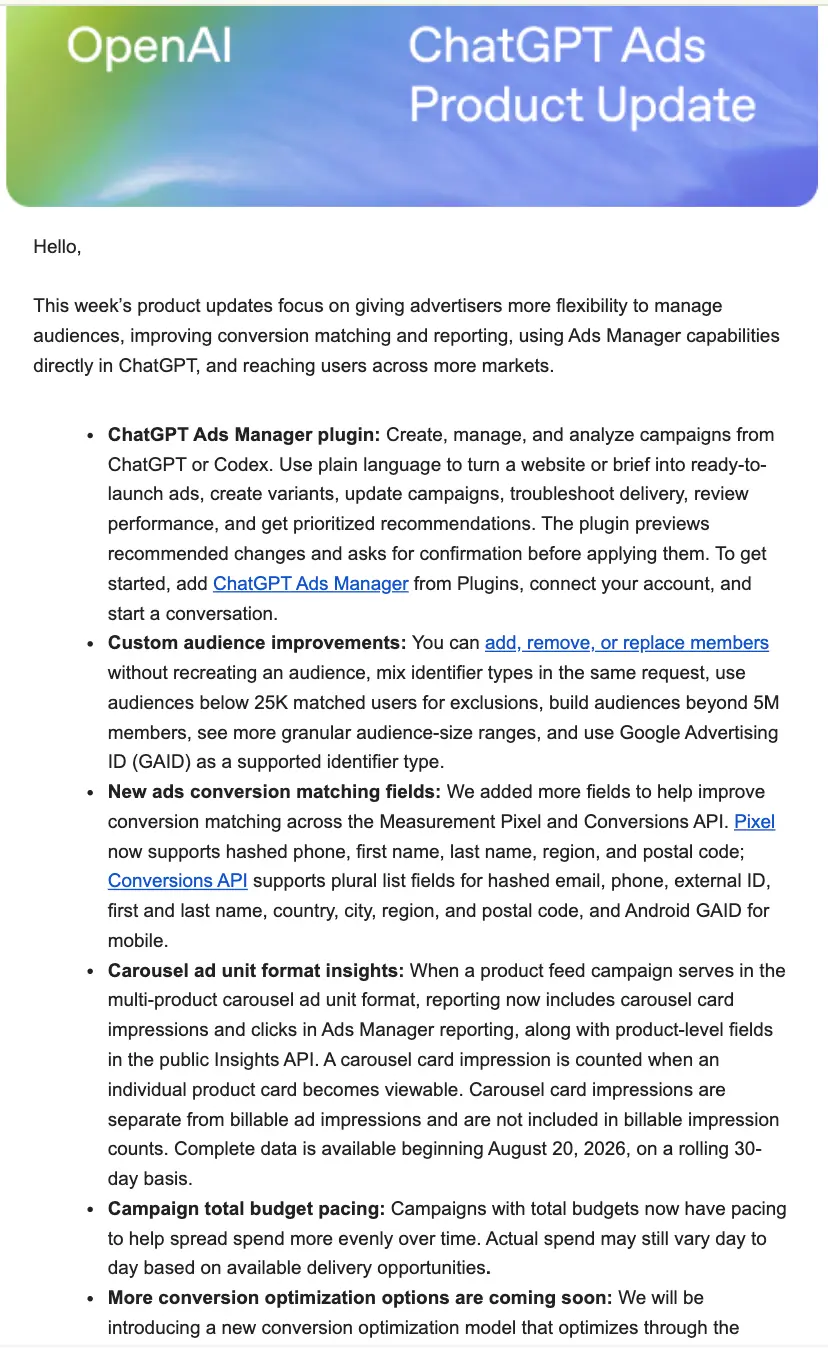
Conversions report at campaign, ad group, and ad level and can drive optimization. Add UTM parameters to your ad URLs so third-party systems including GA4 can see the traffic. Some platforms, such as call-tracking software CTM, integrate directly. ChatGPT also reports impressions, clicks, spend, CTR, average CPC, and average CPM.
Step 7: Optimizing with limited data
The real levers are the ads themselves and how you structure campaigns and ad groups. Very little data explains what is actually driving performance.
To test geographic performance you must build separate campaigns per area, because reporting segments only by country even though targeting goes finer.
OpenAI matches ads using the current conversation plus, for users with ads personalization enabled, broader ChatGPT activity signals. None of it is shared with advertisers — no conversation data, not even the keywords or themes that triggered your ad. It feels like the early days of Performance Max: you largely trust the system.
Case study: how engaged is ChatGPT Ads traffic?
GA4 data covering roughly 1,500 users reaching the same site via each channel:
- Average engagement time per active user: Google Ads 41 seconds / ChatGPT Ads 17 seconds
- Engaged sessions per active user: Google Ads 1.13 / ChatGPT Ads 0.88
- Conversion rate: Google Ads 3.71% / ChatGPT Ads 0.21%
Google Ads users were more engaged and converted at a significantly higher rate. That said, ChatGPT Ads reached people who were not searching for a solution on Google at all. Benchmark across channels, but judge each by what a customer actually costs there.
Where it fits in the mix
Because you reach people mid-research inside an LLM conversation, ChatGPT Ads behaves more like Google Search ads than Facebook or Instagram. Strong organic ChatGPT traffic is a signal worth testing on. OpenAI states clearly that running ads does not affect whether your brand is mentioned organically, and vice versa — organic visibility connects instead to the four fundamentals ecommerce sites should prepare for AI search.
Should you test it?
Most advertisers should. Testing costs are relatively low and will rise as the platform matures and competition enters. Use both in-platform and third-party tracking, benchmark against Google search results, and account for the fact that the platform is new and constantly changing. With no established best practices, expect to invest real time in testing approaches and creative. If you want help structuring paid media operations, get in touch.