Korean beauty retailer Offbeauty is closing in on its 50th store. Since opening its first location in May 2025, it has reached 48 stores nationwide in roughly 18 months — more than Chicor, which operated 21 stores as of September. It fell short of an early-2026 goal of 100 stores by year-end, but it is the fastest-growing of the new beauty multi-brand chains challenging Olive Young. Based on analysis from Korean commerce newsletter TrendLite, here is how its retail expansion strategy works.
Store count drives product supply
Olive Young’s dominance came from building stores everywhere, fast. Each store is a sales floor and, for brands, an advertising space. But as Olive Young’s influence grew, getting listed got harder, and listed brands still fight for limited shelf space. Smaller brands needed new outlets — and unsold inventory needed somewhere to go.
Offbeauty positioned itself as a beauty outlet that sells brands’ surplus stock at a discount. In that model, store count is negotiating power: more stores mean it can offer to take larger volumes from brands.
Agency stores instead of company-owned ones
Olive Young operated about 1,380 stores at the end of 2025, roughly 84% company-owned. Offbeauty expanded mainly through agency (dealer) stores:
- The model was familiar from the company’s fashion roots.
- Company-owned stores put deposits, fit-out, operating costs and failure risk on headquarters; agency stores share that burden.
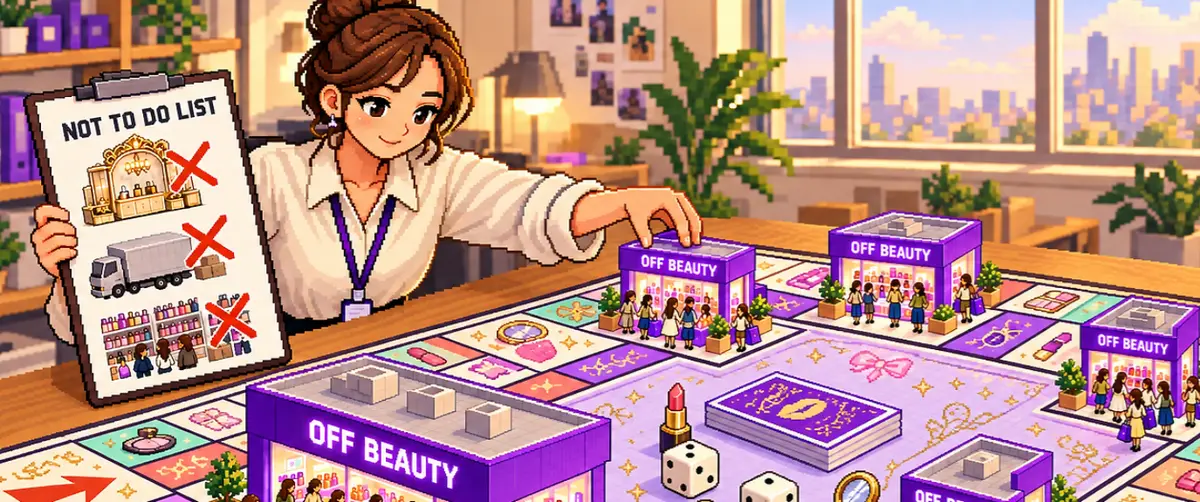
- Offbeauty charges no franchise fee and adds no margin on interiors or fixtures. It makes money by supplying product, not by opening stores.
Doing less, on purpose
While Olive Young invests in large experiential stores and same-day delivery, Offbeauty competes on price alone. Each store carries around 1,000 SKUs — far fewer than rivals — which keeps operations and inventory simple. It also pitches brands on selling offline, where discounted prices are less exposed to online price comparison, and it uses existing delivery platforms for local delivery. It is now testing shelves inside about ten large pharmacies.
After 50 stores, operations decide
Surplus stock rarely comes back on the same terms. When a hit product sells out, a replacement must be found quickly, and because store operators buy from headquarters, sell-through by store matters as much as shipments. Having a lot of inventory is not the same as having inventory people want.
Takeaways for brand marketers
For brands over-reliant on a single dominant retailer, outlet chains offer a way to clear surplus and near-expiry stock while protecting online pricing. Separate outlet SKUs from full-price lines to protect price perception. To grow inside Olive Young itself, see what CLIO learned after a 1,500% ROAS on Olive Young co-op ads.