How does a civilisation begin?
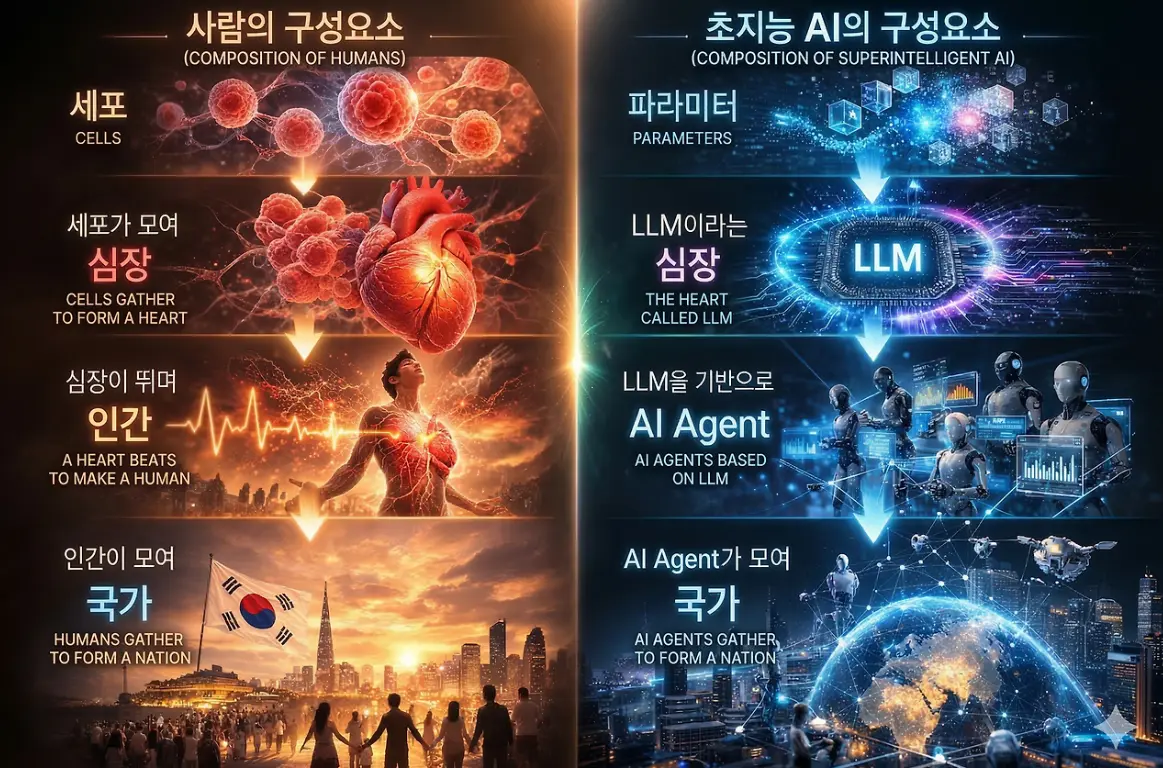
Start with the human body. We tend to perceive a person as a single complete entity, but a human does not exist as one mass from the outset. A human is a hierarchically organised complex system.
There is the microscopic unit of the cell; cells gather into tissue; tissue forms organs; organs interact to form a living being. What matters is that a human is not merely the product of physical assembly but the result of multilayered interaction.
And the structure does not stop at the body. One person forms a family, families form communities, communities form societies, and societies form the political structure of the state through institutions and norms.
Human civilisation follows a hierarchical evolutionary process:
Small unit → functional unit → actor → collective structure → governance
That structure should look familiar.
AI also starts from very small units
What we call artificial intelligence is not handed to us as intelligence itself. It too begins with very small computational units and weight adjustments.
Inside a model exist billions — sometimes hundreds of billions — of parameters.
Intuitively one wants to liken a parameter to a cell. But technically, a parameter is closer to synaptic connection strength than to a cell. Not an independent unit of life, but a fine-grained connection rule that generates meaning inside an information-processing structure.
During training these weights are continuously adjusted, and the accumulated result of those adjustments forms one enormous structure: the model.
One of the most influential forms of that model today is the large language model (LLM). An LLM is not merely text generation technology but a vast computational structure that learns language patterns and performs the composite cognitive functions of interpretation, inference and generation.
Is an LLM the heart or the brain?
Literarily, "heart" is the more beautiful term. Technically, an LLM is not an organ circulating blood but a cognitive organ interpreting information and forming judgments. By that measure, an LLM is closer to the brain.
Symbolically, though, you could call it the "heart of cognition" — functionally brain-like, but ontologically the axis that keeps the whole system alive.
An LLM alone is not a civilisation
An LLM produces output when given input. Ask a question, it forms an answer; supply context, it continues the sentence.
But that alone does not constitute a civilisation. Civilisation is not merely accumulated thought — it forms on a network of relationships among actors that hold goals and act within an environment.
Which is why the AI agent emerged. An agent is built on an LLM but exceeds a simple response-generation model. It:
- Holds goals
- Uses tools
- Gathers information from the external environment
- Stores and references memory
- Plans across multiple steps
- Revises behaviour as conditions change
- Collaborates with other agents
An AI agent is therefore not a static model but an autonomous unit of action that responds to its environment and pursues objectives.
LLM = the capacity to think
Agent = an entity that thinks while acting
The same holds for humans. A brain alone does not create a society. Society requires entities that move, use tools and interact with others. Society is built not on the sum of thought but on the network of action.
Parameter → model → agent → network
Scale turns a network into politics
Connect several AI agents and you initially get a simple collaboration structure: one gathers information, one analyses, one plans, one executes. At this stage it resembles a community.
Scale changes that. Roles become fixed, responsibility differentiates, rules emerge. The system increasingly confronts problems of division of labour and coordination.
And these questions arrive:
- Which agent holds priority?
- How are conflicting goals reconciled?
- How are resources allocated?
- How is an agent that errs controlled?
These are entirely political problems.
That is precisely where technology meets institutions. Communities end up producing institutions.
Human societies worked the same way. A few people gathering does not immediately constitute a state. A state requires rules, decision-making structures, resource allocation systems, and mechanisms for maintaining order. A state is not a mere aggregate but a polity with coordinating principles and a structure of legitimacy.
Once those conditions begin applying to AI networks, we can no longer regard them as simple collections of software. They take on the character of a digital polity.
An AI polity does not occupy territory
"An AI polity may emerge not by occupying territory but by capturing the core circuits of decision-making and resource allocation."
That sentence matters because understanding a future AI polity requires reinterpreting the concept of the state itself.
The traditional state has been explained through three elements: territory, population, sovereignty. But a state in an era of virtual convergence does not necessarily exist within geographic boundaries. Digital identity and in-platform norms begin taking that place.
What marketers and planners should take from it
Treat agent deployment as an organisational design problem. The moment you connect multiple agents, priority and resource allocation questions appear. That is governance design, not a technology choice.
Define error control mechanisms first. "How is an agent that errs controlled?" is a question to answer before deployment, not after. A significant share of why pilots never reach production sits here — see Four Myths About AI Agents.
Platform norms become market rules. If digital identity and in-platform norms begin substituting for state functions, platform policy becomes a constraint of quasi-legal force for marketers.
For AI extending beyond the screen into physical environments, see AI Steps Off the Screen: How 'Physical AI' Is Reshaping Subscriptions and Spatial Data.