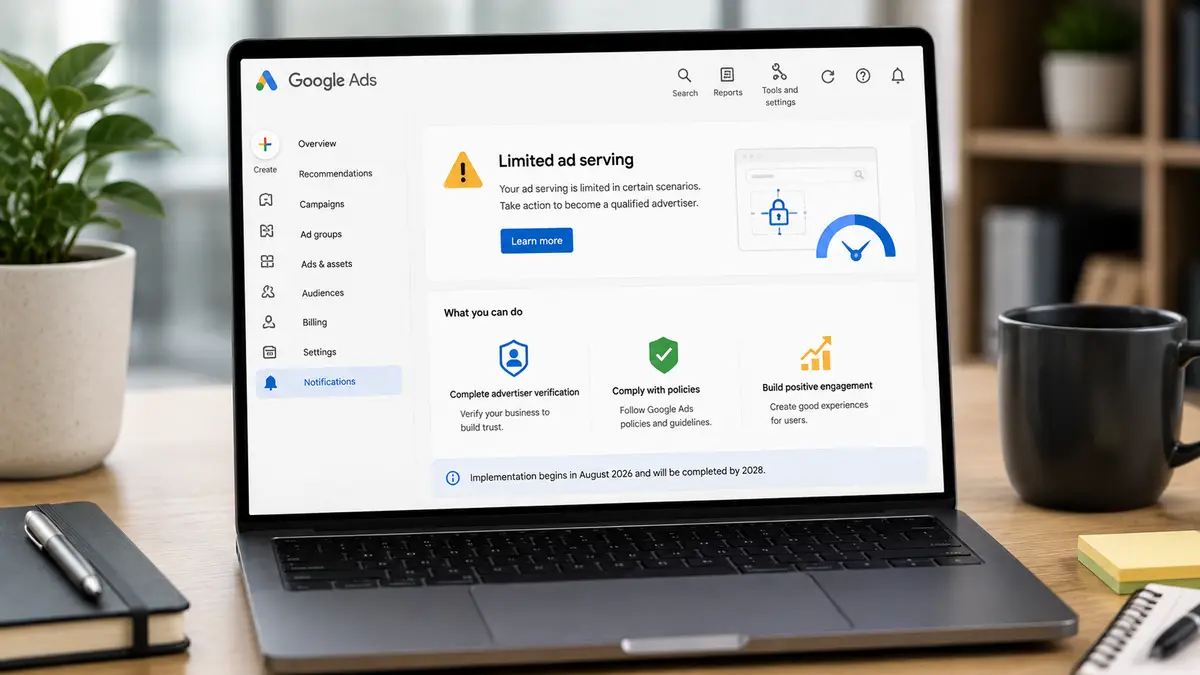
Google is expanding its Limited Ad Serving policy across all Ads, introducing new qualification criteria based on trust signals, verification, and account history.
What changes
The disclosed detail is brief: the policy's scope expands, and eligibility resolves around three axes — trust signals, verification, and account history.
Limited Ad Serving has previously operated as a mechanism restricting delivery for new or unverified advertisers for a period. This expansion effectively makes it the default structure rather than the exception.
What advertisers should check
Verification status. If business information, payment details, and domain ownership are not fully verified, you are the first candidate for restricted delivery.
Account history becomes an asset. Operating patterns that spin up fresh accounts frequently — a new account per client, for example — become disadvantaged. This is the moment to revisit how account ownership and continuity are maintained in agency structures.
Policy violation history directly affects delivery. Accounts carrying accumulated disapprovals and policy warnings lose ground on trust signals.
Reading the pattern
Google has been steadily narrowing advertising eligibility. Requiring government certification for government-document-service ads from October 5 and the allowlist security pilot for Google Ads API manager accounts point the same direction. Ad delivery is becoming a function of account trust, not only bids and quality.
Bottom line
Launching fast from a fresh account just got more expensive. Accumulating verification and history in advance is now itself a media strategy.