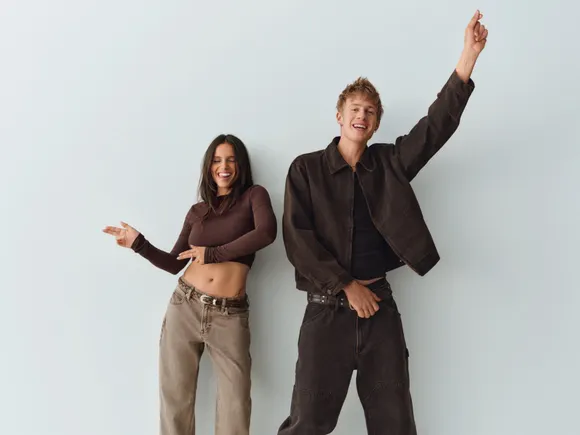
Gap's denim campaign runs a familiar formula
Gap launched "Denim on your own," a fall campaign built around its denim line. It stars Inde Navarrette, the breakout from this year's horror hit "Obsession," and singer-songwriter Malcolm Todd, who recorded a cover of Robyn's 2010 anthem "Dancing on My Own" specifically for the campaign. The music video-inspired spot follows the pair dancing through cavernous white spaces.
The campaign rolls out across Gap's digital and social channels, email, stores and out-of-home, including billboards in Times Square and on Sunset Boulevard. Paid media runs on YouTube, TikTok, Meta and Pinterest, plus creator partnerships.
Credits and product
Tanu Muiño directed, with Gap Head of Creative Calvin Leung on creative direction, Alastair McKimm on fashion and image, and Bjorn Loos as photographer. The featured products are Gap's Mid-Rise Straight Taper Jean, worn by Navarrette, and a '90s Loose Jean worn by Todd. The full fall 2026 collection was designed around fit and versatility, with utility-inspired colorways and updated silhouettes, and lands during peak back-to-school season.
Three elements Gap keeps reusing
Recent Gap work follows a consistent pattern: cast a rising artist and tie it to the brand's history of championing self-expression, rework a nostalgic track for a modern audience, and put choreography at the center of the creative.
Last month Gap partnered with Hailey Bieber on a capsule themed around '90s nostalgia and baggy cuts, soundtracked by The Cranberries' "Linger." Before that, it worked with girl group Katseye on dance-heavy ads set to Kelis' 2003 track "Milkshake." The Katseye tie-up generated 8 billion media impressions and more than 500 million views across platforms, along with double-digit growth in Gap's denim category.
The performance backdrop
Gap grew comparable sales 10% year over year to $796 million in Q1, its 10th consecutive quarter of positive comps. Culture-forward messaging has restored relevance for a once-foundering brand among a Gen Z cohort fond of the Y2K mall era and living inside apps like TikTok.
The takeaway
Gap is not searching for a new idea each season. It repeats a validated format and swaps the variables — song, cast, choreography — while holding the grammar constant, so brand recognition compounds across campaigns. When planning the next one, deciding what stays fixed matters as much as deciding what changes.
For turning a content format itself into brand equity rather than renting a creator, see Bazooka Turns MomTok Rivalry Into a Campaign. For an older brand rewriting its category perception, see Jif Reworks Its Logo to Escape the PB&J Box.
FAQ