Every week brings another headline about the future of search. Google is losing ground. ChatGPT is growing. Reddit is where people trust. TikTok is replacing Google for younger audiences. YouTube is a search engine now.
From outside, search looks increasingly fragmented. SearchPulse research at Reflect Digital suggests the real shift is somewhere else: confidence.
The data only looks contradictory
At first glance the findings conflict. 56% of people regularly use AI search, yet 57% still fall into the Traditional Searcher segment. Both are true, because people are expanding their search journey across more platforms.
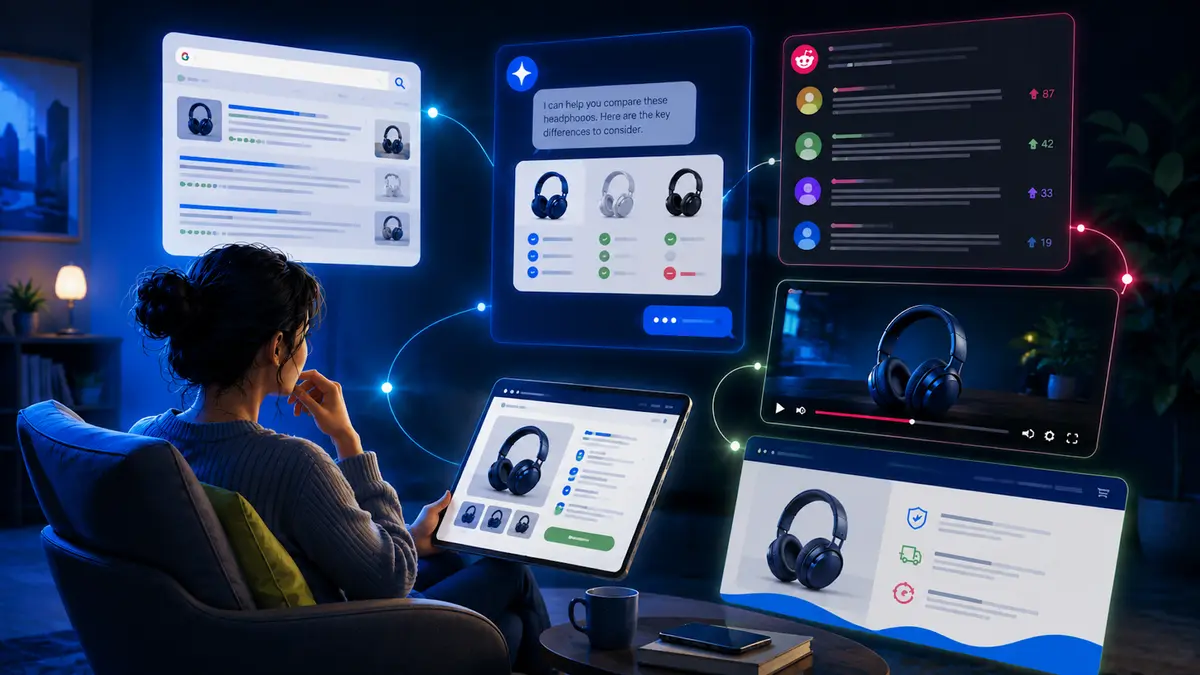
The fastest-growing audience is the multi-platform searcher — people who move naturally between search engines, AI, communities, creators, and brand websites before deciding. They are assembling confidence from multiple places.
Search behavior does not follow the funnel
Marketing has spent years mapping customer journeys — funnels, the messy middle, touchpoints. All of that still has value.
What traditional journey mapping misses: people do not consciously move from awareness to consideration to purchase. Nobody thinks "now I'm going to Google" or "now I'm entering the evaluation stage." They keep resolving uncertainty until they feel confident enough to act. Every interaction fills a different confidence gap.
Platforms serve different confidence needs
The research identified four consistent psychological drivers:
- Fact finding: "I need accurate, trustworthy information."
- Crowdsourcing: "What do people like me think?"
- Taste tuning: "Does this feel right for me?"
- Autopilot: "Help me get this done."
These motivations did not appear because AI did. They have always existed. What changed is which platform satisfies which one.
YouTube is not winning because people like video. Watching removes uncertainty in a way text often cannot. Reddit is not valuable as another search engine — communities provide reassurance through shared experience. AI excels at rapid understanding, Google still matters for verification, and brand websites reassure you that you are buying from the right company.
Platforms are specializing in different confidence needs.
The real challenge is not the channel
Most marketing teams are still organized by channel: SEO, paid search, social, PR, content. Customers do not think that way. They move between confidence signals until they are ready to decide.
The challenge is not deciding which channel matters most. It is understanding which confidence gaps your audience still has and helping close them.
Four questions for closing confidence gaps
1. What confidence does this audience need before buying?
It varies. A first-time customer needs different reassurance than an existing one. A CFO needs different proof than a marketing manager. A $20 purchase is not a strategic B2B partnership.
2. What confidence assets do we already have?
Content that acts as evidence reducing uncertainty: customer reviews, case studies, original research, expert opinion, product demonstrations, industry recognition, community recommendations, founder expertise. Each answers a different gap — a documented portfolio of real project outcomes is one of them.
3. Where will people naturally discover those assets?
Here platforms re-enter the conversation. Different audiences look in different places for different reassurance. The same Trustpilot review can influence someone through a Google result, an AI answer, your own site, or a direct visit to Trustpilot. The asset stays constant; the discovery point changes.
4. How will we know confidence is building?
Some confidence is directly observable — traffic, leads, sales, conversions. Increasingly, some is built where you will never fully attribute it: someone reads Reddit before searching your brand, watches a YouTube review, asks ChatGPT to compare suppliers, sees your research cited by an AI assistant.
Those moments influence decisions without appearing in analytics. Which means you have to stop judging every confidence-building activity by performance marketing metrics alone. Some assets exist to generate clicks; others exist to reduce uncertainty. Both contribute to growth. On what earns AI citations specifically, see the finding that 76% of AI-cited pages were updated within 30 days.
The question after visibility
As AI and zero-click experiences grow, marketers will lose visibility over parts of the journey. Understanding how confidence gets built is still possible.
Shift the question from "which channel drove the conversion?" to "which confidence gaps did our marketing help close?"
Search is fragmenting across platforms, but the questions people are trying to answer are the same. They are just assembling answers from more places than ever. The brands that win will understand how confidence is built and be present wherever their customers need it.