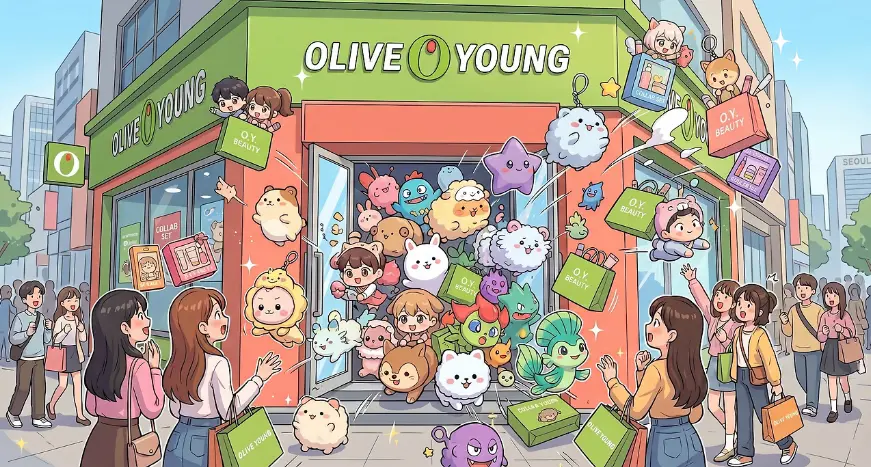
The era of buying cosmetics and getting a character as a bonus has flipped: now people buy the character, and cosmetics come with it. What's currently dominating Olive Young's stores and mobile app home screen is a set of mega-IP collaborations with intense fandoms — Sanrio, Pokémon. For consumers who hesitate to buy, a globally beloved IP with obsessive fans has become the most compelling trigger to open their wallet.
Mega IP Collabs Have Saturated Olive Young
The scale alone shows how hot this trend has gotten. The Sanrio collaboration involved 30 brands and roughly 200 products; the Pokémon collaboration drew about 60 brands and roughly 230 products. Character IP is no longer a simple giveaway or freebie — it turns price competition into collectible-value competition, pulling in both character fandoms and Gen Z as new customer segments.
From Exposure to Conversion
The problem: this strategy has already hit saturation. As mid-size and large brands with both capital and planning capability all rush into IP collaborations, competition has only intensified. As one report puts it, "the first-half battle of grabbing attention by slapping on a character has become a baseline skill everyone already has." No matter how cute the packaging, it means nothing if it doesn't convert to a completed purchase.
Collaborative Ads: The New Battleground
So the fight has shifted from exposure to conversion. The solution getting attention is Collaborative Ads built on the retail platform's own 1st-party data. Using real behavioral signals Olive Young has accumulated — product views, cart adds — ads are shown precisely to users with high purchase likelihood.
The performance numbers back this up. Interactive ads lifted purchase likelihood by 420 percentage points over plain banners; a Witch's Pouch campaign hit 551% ROAS and a 30% cart conversion rate. Collaborative ad unit costs dropped from ₩30 to ₩20.
The message is clear: securing an IP license is only the first half. The real competition happens in the second half — carrying the consumer all the way to a completed purchase.
What This Means for Marketers
The fact that character IP collaboration has become table stakes is an important signal. When everyone holds the same weapon, differentiation comes not from the IP itself but from funnel design after the IP catches attention. Separate creative that grabs interest (first half) from data-driven retargeting that converts it (second half), and track each stage's metrics — view-to-conversion rate, cart conversion, ROAS — independently.
Retail-platform collaborative ads built on 1st-party data also reaffirm the value of retail media amid tightening privacy regulation and the decline of third-party cookies. Access to real purchase-behavior data that's hard to get from owned channels alone means that going forward, which platform's data and ad inventory you partner with may matter as much as which IP you secure.
If you're designing a data-driven collaborative ad strategy for retail media, Best Partner's services can help, or get in touch.