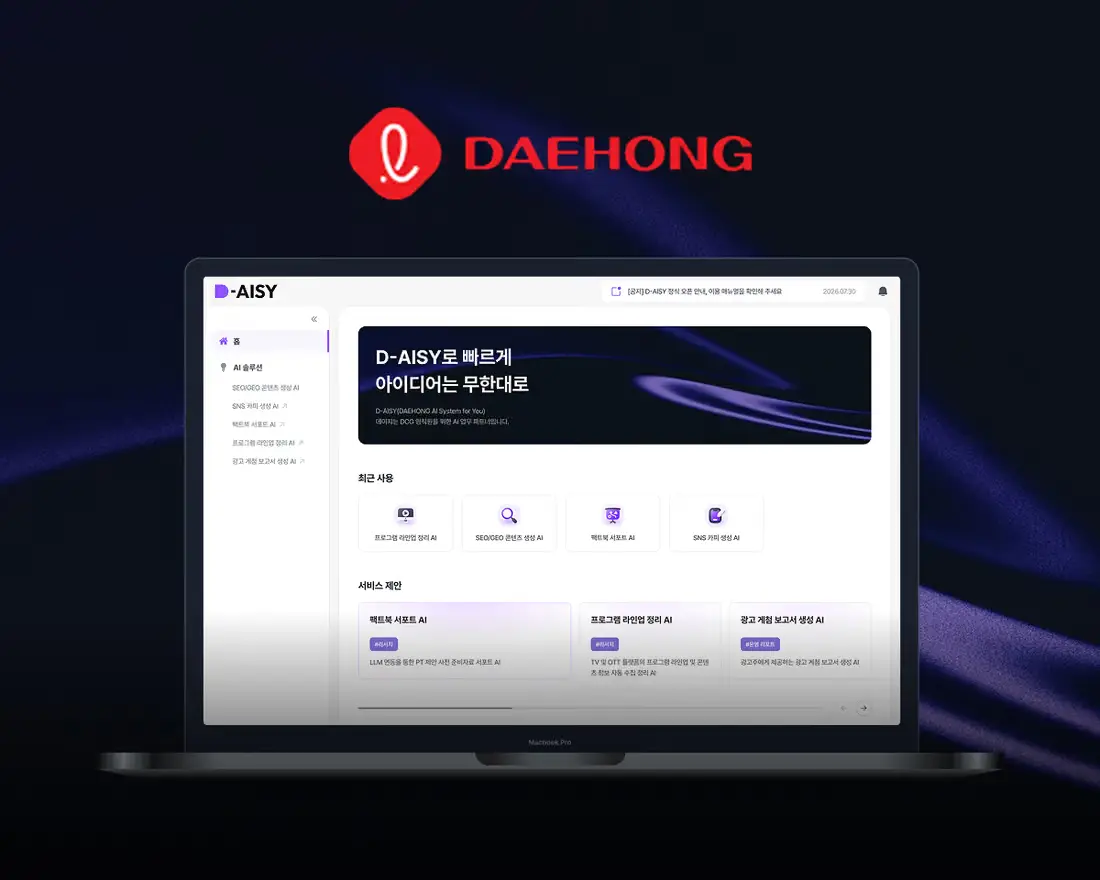
An in-house AI platform succeeds on operating rules more than on model choice. That is the lesson from D-AISY, built by Daehong Communications — the Lotte Group’s full-service ad agency — with developer partner Ttokttokhan Developer. The agency was spending two days collecting broadcast and OTT schedule data, one to two hours daily rechecking pages for schedule changes, and another two days researching material for client meetings.
Why an internal platform
Time was not the only issue. Employees were already using outside AI tools for tasks like fact books and social copy, so work context and files were scattering outside the company. The team built individual AI tools and an internal AI portal to manage them at the same time.
Inside D-AISY
Five task-specific AI tools in one place
Staff sign in with company accounts and use every internal AI service from one screen. The core structure covers login and permissions, a home screen, workflow and AI agent menus, and admin analytics. Five solutions include ad report automation, a program lineup AI, fact book support and social copy generation.
The program lineup AI
The first release centered on schedule data. It runs scheduled jobs to research new programs and detect schedule changes, and when a user uploads a programming grid, it extracts and stores the details by field.
What changed versus ad hoc AI use
- Knowledge stays in-house: the platform records who delegates which tasks to AI and how, and admin analytics show what to build next based on real usage.
- Only human-approved results go live: work flows through AI processing, automated validation and human-in-the-loop review. Parsed schedules land in a needs-review state until an owner confirms them, while routine research and change checks auto-publish once they pass validation.
- Existing tools plug in: a YouTube daily report automation the client had been building was connected rather than scrapped.
What took the longest
Legally safe data collection
Because the system depends on AI search and crawling, copyright and legal review came first. Instead of scraping pages directly from its servers, the system pulls URLs through official Naver and Daum APIs and passes them to Google Gemini’s URL context feature to read the content. Proposing options the client’s legal team could review, then agreeing on direction from test results, consumed the most time.
Quality safeguards
Early versions skipped items when a first search failed instead of retrying with new queries, and the team consolidated a multi-model setup into a single model. Inconsistent English spellings of OTT names were fixed by standardizing on Korean names. Search was limited to 20 major news domains, failed jobs retry up to three times, and schedule saves are wrapped so any mid-process error rolls everything back.
What’s next
Phase two focuses on sharing prompts and workflows searchable by department, role and tag, plus admin views of participation by team. A mockup image generator and a competitive pitch assistant are also in the works.
What this means for marketing teams
The hardest part was not the model or the interface but deciding what data can be used, how it can be collected, and who catches wrong outputs. Before comparing tools, list which tasks must always be human-checked and which can run automatically. A similar lesson appears in Internal AI Agents Need Data Structure Before Models — How Buzzvil’s ‘Iris’ Took Hold in a Public Channel.