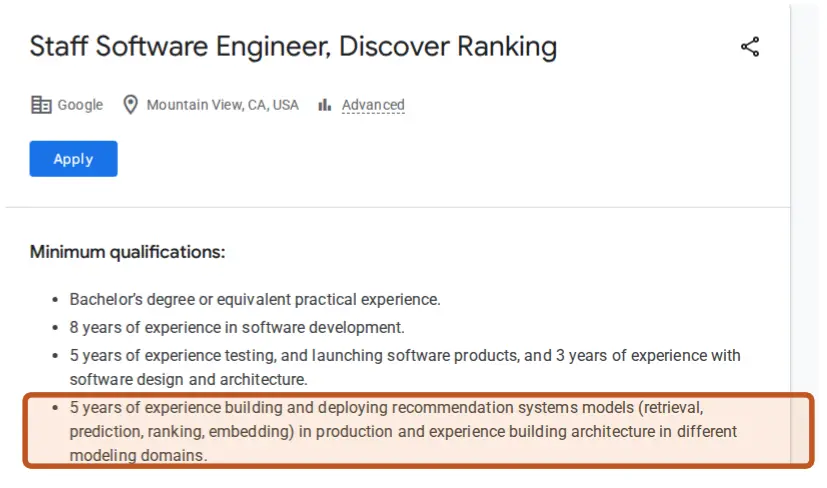
Google rarely explains how Discover works. But a recent listing for a Staff Software Engineer, Discover Ranking in Mountain View said more than intended. One line in the minimum qualifications: "5 years of experience building and deploying recommendation systems models (retrieval, prediction, ranking, embedding) in production." Four words — and rare official confirmation of the Discover recommendation system's building blocks.
What makes it interesting is the overlap. Research group 1492.vision has monitored real Discover feeds for two years — 42 million cards and counting — and three of those four words match layers they had already traced from the outside.
Three layers visible in the data
Retrieval: about 20 candidate pipelines
Before anything gets ranked, the system decides which articles and videos are even eligible for your feed. The researchers mapped roughly 20 pipelines feeding Discover: candidate sampling dominated by editorial content, post-retrieval evaluation made almost entirely of YouTube and X content, trend-embedding channels, item-item collaborative filtering. Notably, a generative retrieval channel — consistent with LLM-driven candidate selection — appeared as early as September 2025 in roughly 0.03% of the French feed: a tiny, quiet test.
Prediction: attention and engagement move independently
Every observed card carries around nine prediction scores between 0 and 1, collapsing into two nearly independent dimensions: will the user stop on this card (attention), and will this specific user click and read deeply (engagement). The correlation between them is close to zero — the clickbait pattern captured in one statistic: a headline can grab attention without holding it.
The biggest measured effect is personalization. Comparing two sports publishers with nearly identical topic potential, the one with stronger learned reader affinity received deep-engagement predictions about 2x higher and final amplification roughly 8x stronger. The striking detail: the amplified publisher had fewer followers among the panel accounts. The Follow button is one input among several — what dominates is the affinity the model has already learned between readers and the source.
Embedding: several named vector families per user
The observations suggest Google maintains multiple embedding families per user — Discover interests (with a short-term variant), trends, real-time, and a shopping-related family — feeding a classic two-tower retrieval setup where recommendations are driven by proximity between user and content vectors.
Our take: distribution follows the relationship, not the follower count
Three takeaways for publishers. First, reader affinity is a direct distribution lever: at equal topic potential, a history of readers repeatedly and deeply engaging with your content produced an 8x amplification gap. Second, attention and engagement are separate diagnostics — improving click-through and improving read-through are different jobs, and fixing one won't move the other. Third, engagement is only half the story: the posting itself says "more engaging, and useful," and the usefulness signals haven't been traced yet.
Reverse-engineering a platform from outside its documentation is a familiar exercise — we did the same reading in We Read X's Algorithm Source Code — 17 Filters Matter More Than the Weights, where eligibility also mattered more than scoring. And when platforms do publish their own guidance, it pays to take it literally, as with Instagram Published Its Caption Playbook — Captions Are Search Text Now. Lay official statements over observed data, and algorithm response stops being guesswork.