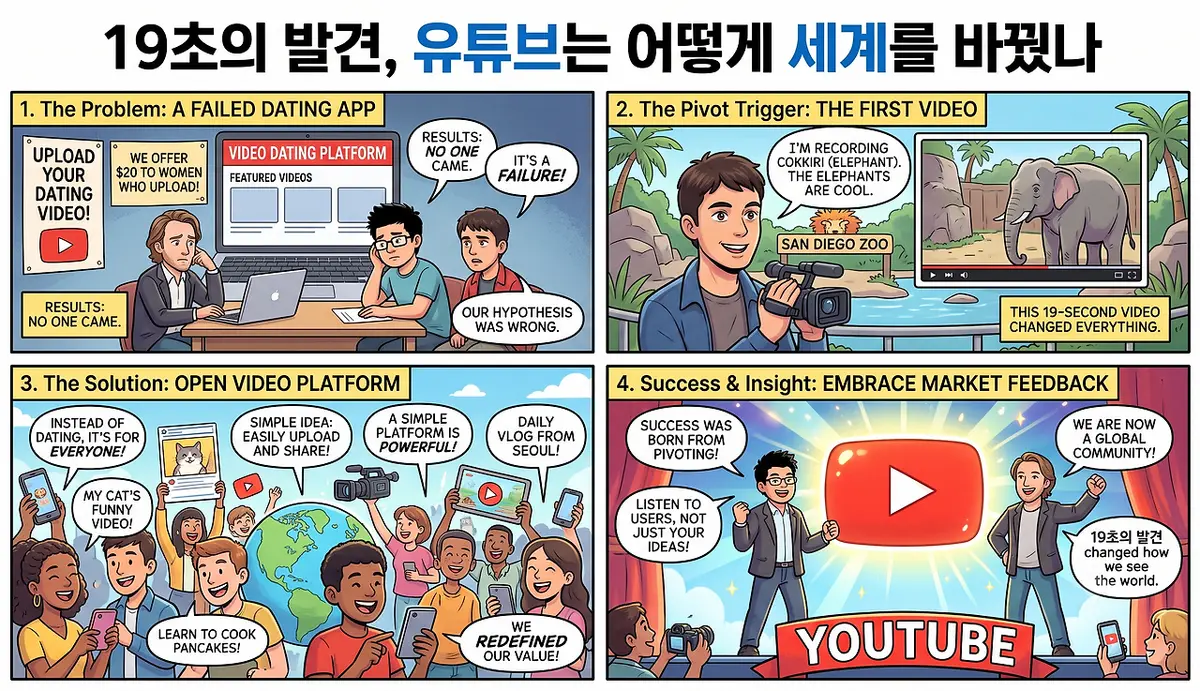
The video platform that defines the internet began as a video dating service. After watching what users actually did, its founders pivoted to open video sharing — the textbook case for putting market response ahead of the founding hypothesis, and the clearest argument for pivoting as a discipline.
A good idea nobody acted on
In February 2005, PayPal alumni Steve Chen, Chad Hurley and Jawed Karim built YouTube around a simple idea: people upload self-introduction videos and find matches. Compared to text-and-photo dating services, it promised far more authentic self-expression.
Users did not cooperate. Almost nobody wanted to film themselves for a dating context. The founders eventually posted on Craigslist offering $20 to women who uploaded videos — and got zero participants. The crisis was not a bad idea; it was an idea disconnected from real usage context.
The 19-second video
The turning point came from observation, not innovation. Founders noticed that users wanted to upload ordinary things — everyday moments, a trip to the zoo, playing an instrument — rather than dating profiles.
On April 23, 2005, co-founder Jawed Karim posted "Me at the zoo," 19 seconds from the San Diego Zoo. A crude clip whose entire content is a remark about elephants having long trunks became the historical marker that the service's real value was not relationship formation but effortless recording and sharing.
Instead of asking "why won't people upload dating videos?", the team asked "in what situations do people want to upload video at all?" — and dismantled the dating fence entirely.
Simplifying the value proposition
After the pivot, the value proposition became startlingly simple: anyone can upload video easily, and anyone can share it. Not a feature addition but a redefinition of why the service existed.
That collapsed the barrier to entry. Inside a dating service, motivation to submit video is narrow. In a general sharing platform, motivation multiplies — entertainment, documentation, information, expression, fandom, learning. YouTube absorbed all of it.
Timing helped
Internet users were shifting from text and image toward video expression, and latent demand for an easy place to upload and share was building. The team read that not as an abstract technology trend but as a change in observable user behavior.
Crucially, YouTube did not succeed by announcing an ambition to become the world's largest video platform. It succeeded by catching a very specific reality inside a 19-second clip: people want to show themselves through video. The grand vision arrived afterward.
Pivoting is an attitude problem
Most startups fail to pivot not because they cannot read data but because they cannot let go of attachment to the original idea. What makes YouTube instructive is that the founders — desperate enough to offer $20 bounties — still accepted what the market showed them. A pivot is not failure or retreat; it is the result of learning.
Five lessons
- Do not turn your first idea into a belief: an early hypothesis is something to test, not defend
- User activity is the best data: real usage patterns beat surveys and speculation
- Act decisively when you find a bigger problem: video sharing was a vastly larger market than dating
- Simple value propositions win: "anyone can upload and share" beat any elaborate explanation
- A pivot is redefinition, not surrender
For why organizations resist new direction structurally, see You Adopted AI and Nothing Changed; for how leaders set standards through change, see "You Changed After Becoming a Manager" Is Not a Failure Signal.