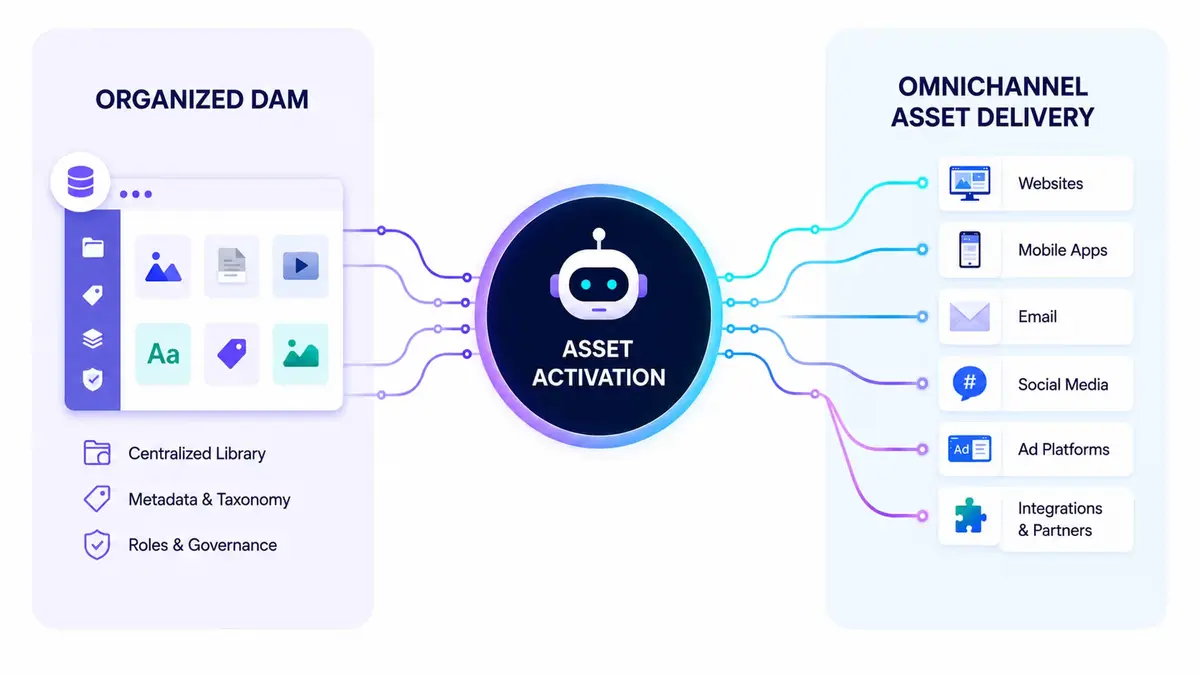
Digital Asset Management systems have done a good job solving the library problem — centralized storage, metadata, governance. What they have not solved is the activation problem: getting the right asset, in the right format, to the right channel, at the right time.
Well organized, still too slow
62% of respondents say content demand has already increased 5x or more over the past two years — yet activation workflows have stayed static. The distance between an asset sitting in a DAM and its actual arrival in front of customers, properly formatted and on time, is what's being called the Content Activation Gap.
Five shifts DAM platforms need to make
1. Portal downloads → headless integration. Manual portal downloads don't scale. Headless API access lets ecommerce platforms pull images on demand and tools like Figma push designs automatically.
2. Stored exports → on-demand variants. Instead of pre-generating every size, URL-based transformations create variants in real time — a single 6MB original can serve as a hero image, thumbnail, social preview, and mobile variant simultaneously.
3. Manual upkeep → autonomous AI agents. AI-powered systems enforce quality control, apply consistent tagging, and maintain governance without scheduled cleanup sprints — essential once the downstream consumer of an asset is itself an AI agent.
4. Hopeful search → AI-powered discovery. Natural language queries and visual search replace keyword matching, since inconsistent tagging (like "T-shirt" vs. "TShirt") now causes retrieval failures that can break production, not just annoy a designer.
5. Standalone DAM → an MCP-connected stack. Model Context Protocol integration lets developers in their IDE, marketers in a copilot, and automation agents access assets directly without switching apps.
DAM as infrastructure, not a destination
ImageKit, which published this analysis, positions its own offering around a combined image/video API and AI-powered DAM — real-time media optimization, 50+ transformations, templated creative automation, and visual search, serving more than 300,000 developers and 3,000 businesses. The framing shift is clear: DAM should be judged less on how well it stores assets and more on how fast those assets reach customers across channels and AI workflows.
The takeaway for marketing teams
As AI agents increasingly execute real tasks — bookings, purchases, personalized content delivery — your asset infrastructure needs to be ready for agents to consume directly, not just for humans to browse. When evaluating or upgrading a DAM, ask less "how well does it store?" and more "how fast does it activate?" To review your headless API and MCP integration roadmap, explore Best Partner's services or get in touch.