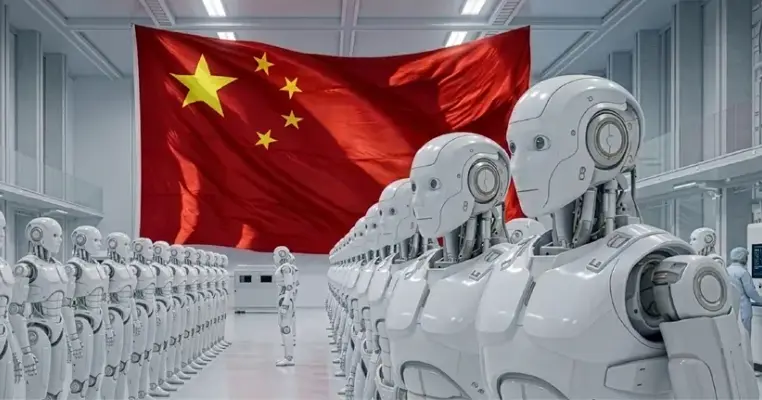
Humanoids are the loudest topic in global robotics right now, and Chinese companies are moving fastest. State-led industrial policy, large-scale investment, a deep component supply chain and manufacturing capacity are operating at once, pushing products to launch and toward mass production quickly.
China's Speed Doesn't Come From Any Single Technology
China has published a roadmap to build a humanoid robot innovation system by 2025 and an internationally competitive industrial ecosystem by 2027. It has designated humanoids a strategic future industry, with Unitree, AgiBot, UBTech and XPeng pursuing commercialization across manufacturing, logistics and services, per Reuters and USCC reporting.
The advantage is not one breakthrough. It is the combination: fast productization, low manufacturing cost, a dense component ecosystem, large-scale pilot environments, and government support all running simultaneously. Which leaves one question open — does rapid humanoid progress mean humanoids will dominate industrial floors?
What Industrial Sites Actually Ask
Operations stability outranks technical spectacle on a factory floor. Customers are not checking whether a robot walks, runs and climbs stairs like a person. The questions are far more specific.
- Can it run stably 24 hours a day?
- Does it perform repetitive tasks at consistent quality?
- How fast does it recover when something fails?
- Does it integrate with existing equipment, processes, WMS, MES and PLC?
- Does it raise productivity in proportion to the investment?
That last item is not calculated from equipment price. It spans installation time, downtime, maintenance, cycle time, MTBF, spare parts and operating headcount. What a customer buys is not a robot's form factor. It is productivity.
Human-Shaped Robots vs. Task-Shaped Robots
Humanoids have real advantages in environments designed for humans: stairs, doors, handles, varied tools, unstructured movement paths. Services that a person must perform, disaster response and some high-difficulty manufacturing work are plausible humanoid territory.
But Most Sites Are Already Designed for Automation
Across much of manufacturing and logistics, work paths are standardized and movement routes are predictable. In those environments, a form optimized for the task frequently outperforms a form optimized to resemble a person. The fast-spreading pattern combines industrial robots with AI vision, autonomous mobile robots and mobile manipulators, integrating perception, mobility and manipulation into a single system.
So the operative question on site is not "humanoid or not." It is which form automates this task most reliably, most economically, and soonest.
Where Korea Sits
Korea's strengths are its manufacturing base, the sophistication of its semiconductor, automotive, battery and logistics industries, high robot density, and accumulated experience in precision control and systems integration. The government launched the K-Humanoid Alliance in 2025 with a stated goal of becoming a global humanoid power by 2030.
The competitive split runs roughly like this: China expands the market on manufacturing ecosystem and policy momentum, the U.S. pushes general-purpose robot intelligence on AI models and big-tech capital, and Korea accumulates real-deployment experience inside advanced production lines.
What Business Teams Should Take From This
The argument is not specific to robotics. Every new technology category repeats the pattern: the form that demos impressively and the form that pays back on site are different, and press attention concentrates on the former. The same dynamic shows up in why the AI gap between companies tripled in six months — the separation came from organizations that fitted tools to their actual work, not from those that adopted first.
Robots follow the same rule. The winner may not be whoever builds the most human-looking machine, or the fastest-walking one. Competitiveness is determined by how much human work gets removed, not by how closely a machine resembles a human. It is a contest of problem-solving on site, not a contest of form.