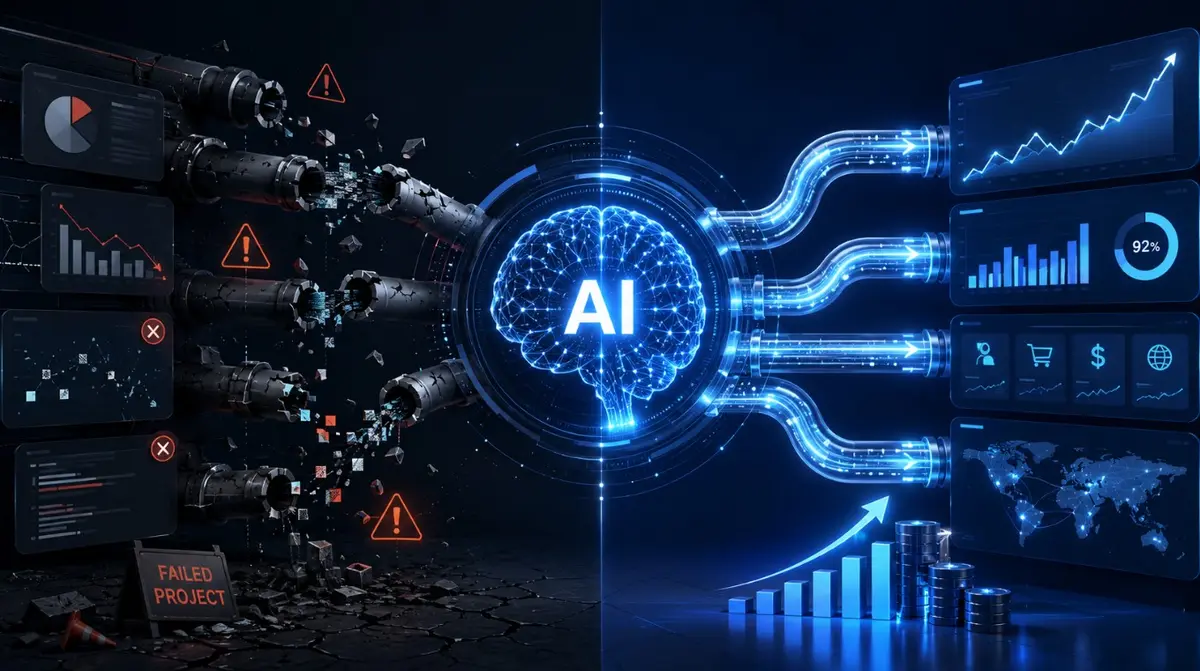
A garage with the finest Ferrari, loaded with cutting-edge self-driving software, still won't move an inch with an empty fuel tank. That's the metaphor at the center of a stark diagnosis of enterprise AI failure: the problem with most generative AI projects isn't the model's capability — it's the absence of infrastructure that keeps real-time data flowing into it.
The Numbers Are Blunt
Only 12% of enterprise AI proofs-of-concept survive to actual deployment; the other 88% stall out along the way. The average cost of that failure runs about $8 million per company. Gartner's own projection is similarly grim: two-thirds of companies preparing for AI transformation are expected to drop out along the way.
An Outdated Idea of What Data Is For
At the root of this failure is an old mental model of data. Traditional companies, financial institutions especially, have long treated data as a warehoused asset for after-the-fact analysis. Leading global banks, by contrast, treat data as a real-time event stream measured in milliseconds. That gap shows up concretely: domestic loan processing that moves in minutes versus global banks reacting in milliseconds. Data has to become an "event trigger" that actually drives systems, not a "receipt" that merely proves what already happened — and without that flow, even the most powerful LLM is useless.
The Fix Is Automating the Flow
The path forward is redesigning existing workflows around data flow, finding the disconnects between systems, and eliminating "manual bridges" — the copy-and-paste-into-a-spreadsheet habits that quietly break automation. That means breaking down departmental silos, building internal capability with automation tools like n8n, Make, and Zapier, and capturing employee know-how as structured "features" an AI system can actually learn from. Payments platform Stripe rebuilt its data architecture entirely around real-time event streaming, and firms like Goldman Sachs and Bank of America have realized real ROI from pipeline investment.
The piece also frames this historically: 2000s-era process innovation (PI) obsessed over procedure but lacked the technology to execute it, while 2010s digital transformation (DX) stopped at the website-and-app layer without touching core business processes. AI is the first tool capable of hitting both technology innovation and process innovation at once — but without real-time event APIs and someone accountable for the data pipeline, it lands right back in the failure column.
What Marketers Should Take From This
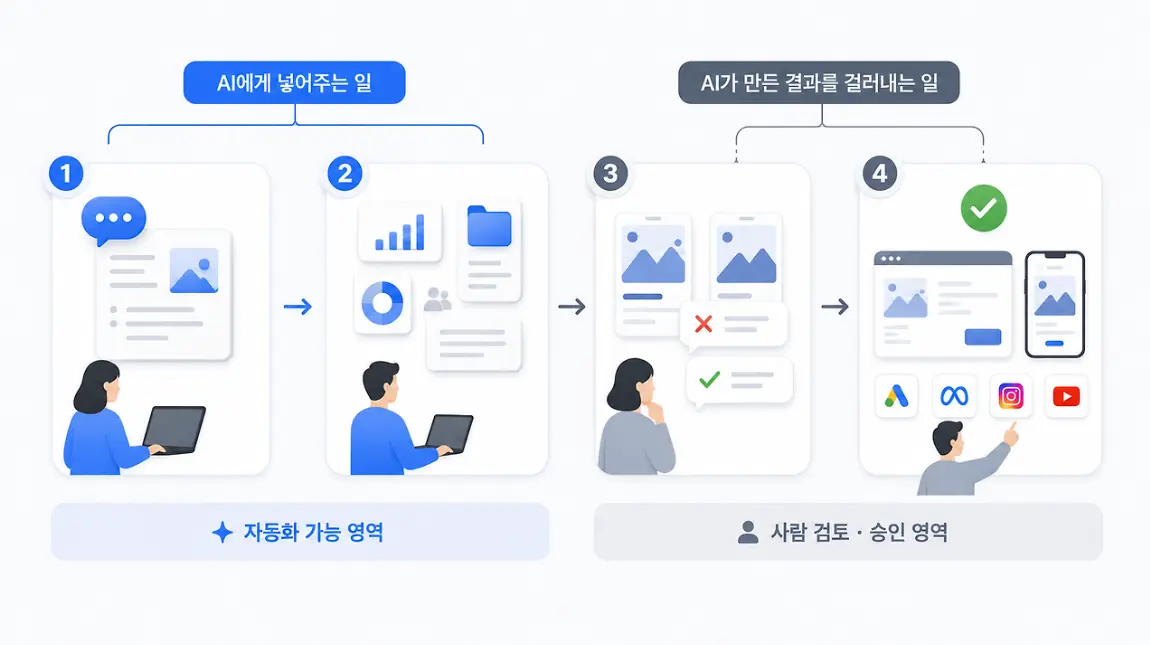
For marketing organizations, this is a reason to reconsider how AI tools actually get adopted. It's easy to get drawn to flashy "AI features" — content generation, segmentation, campaign automation — but what actually determines success is whether the CRM, ad platforms, analytics tools, and CDP are connected in real time, with data flowing without interruption. If data sits siloed by channel and reports get manually stitched together by hand, even the best AI becomes that Ferrari with no fuel.
The question marketing organizations should ask first isn't "which AI model should we use," but "is our data actually flowing in real time." Diagnosing the disconnects between departments and systems, and replacing manual bridges with automation, has to come before AI investment can land in the surviving 12% rather than the failing 88%. For related reading on how the biggest AI companies are solving exactly this execution gap, see our piece on why AI giants invested in people, not models. If you need help auditing your marketing data pipeline before an AI rollout, Best Partner's services can help.