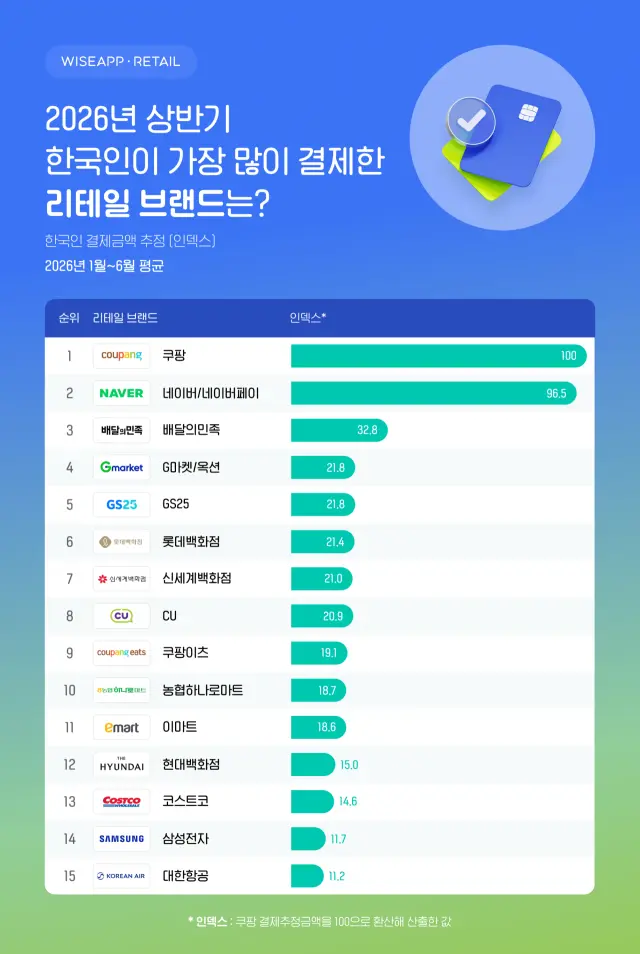
An analysis of sampled credit and debit card transactions by WiseApp/Retail shows Coupang held onto the top spot among Korea's major retail brands by estimated average monthly payment volume in the first half of 2026 — but the gap with its closest rival has narrowed sharply enough that it's now effectively a two-way race between Naver and Coupang for payment volume.
Naver closes in on Coupang
Indexing Coupang at 100, Naver and Naver Pay scored 96.5 — a striking narrowing of the gap at the top. Baemin (Woowa Brothers' delivery app) trailed distantly in third at 32.8, followed by Gmarket/Auction and GS25 (21.8 each), Lotte Department Store (21.4), Shinsegae Department Store (21.0), and CU (20.9).
Convenience stores dominate by payer count
The rankings flip when measured by number of unique payers. With nationwide store networks, GS25 and CU both topped 30 million payers, taking the top two spots, while Coupang came in third at 26.1 million. Daiso, 7-Eleven, and Naver/Naver Pay followed at roughly 20 million each, with Baemin at 16.74 million and Mega Coffee at 14.51 million.
Two different kinds of scale
The key insight is that "largest by payment volume" and "largest by user count" measure very different things. Coupang and Naver each capture high spend per customer, while convenience stores win through a much larger base of users making frequent, smaller purchases.
What this means for marketers
This data reopens the question of which metric should define success for a given campaign. Payment volume reflects revenue contribution; payer count reflects reach and touchpoints — so the right benchmark and KPI depend entirely on the campaign's goal. Naver's near-parity with Coupang in payment volume signals that a commerce ecosystem tying together search, pay, shopping, and membership has become a central variable in e-commerce competition.
Meanwhile, convenience stores' overwhelming lead in payer count shows that brands with physical retail footprints still have a powerful retail-media opportunity. By converting repeat visits and high payment frequency into membership, app engagement, and retail media advertising, these brands can build a differentiated marketing asset entirely distinct from the top platforms by payment volume.
If you're evaluating which commerce channels and KPIs fit your brand's goals, Best Partner's services can help you build the right measurement framework, or get in touch to discuss your strategy.