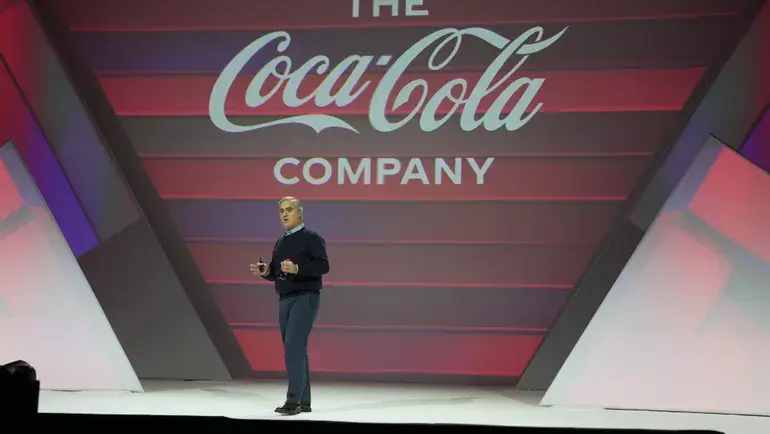
Coca-Cola’s marketing transformation began with a change in what the company measures. Speaking at the ANA Masters of Marketing conference on Oct. 21, global CMO Manolo Arroyo explained how the beverage giant moved away from brand love as its key metric and toward total consumer base, a behavior-driven measure tied directly to growth.
The three problems Coca-Cola faced in 2020
When Arroyo took the role at the start of 2020, Coca-Cola had three burning issues:
- No consumer growth: for almost two decades it was not recruiting new consumers in total.
- Late to digital: despite its advertising heritage, it was slow to embrace digital marketing.
- Fragmentation: roughly 2,000 marketing programs, 3,000 new product launches a year and more than 6,000 agencies worldwide.
From brand love to total consumer base
Rising brand love did not reliably translate into brand performance. Coca-Cola shifted to total consumer base as “the primary correlation and causation of growth” in its P&L, then worked backward to understand which equity drivers change behavior for which audiences. As Arroyo put it, love can increase too, “but it follows the behavior.”
The company then focused on four areas:
- Portfolio pruning: from more than 400 brands to about 170, including 32 billion-dollar brands.
- Bigger, bolder innovation instead of thousands of small launches.
- Digital marketing: digital was under 30% of media spend in 2019 and will be about 70% by the end of this year. In 2021 the company created Studio X, a connected network that runs creative and media on common data and tech.
- A redesigned marketing operating system, internally and with external partners.
Why the first moment matters
Arroyo describes a brand as “a promise… delivered through experiences that leave a long-lasting memory.” Per Coca-Cola’s data, half of memory generation in beverages happens the first time a consumer interacts with a brand, online or offline, which makes retail experiences critical. In an AI-saturated world, live experiences in sports, music, food and culture help brands stand out, with digital acting as the connective tissue.
Since the shift, Coca-Cola says it has added 160 million new consumers, grown its top line, expanded margins and improved return on invested capital.
The new agency lineup
On Oct. 22, Coca-Cola completed its global marketing operating system review and picked Omnicom as its North American media partner. WPP Open X remains global media partner outside North America and global creative partner, while Dentsu keeps media in Japan and South Korea. Publicis, which won North American media last year, withdrew after taking on PepsiCo’s global media duties. Omnicom will connect media, data, CRM, loyalty and creators in North America, with the new structure rolling out in phases from Dec. 1.
Takeaways for marketers
- Check whether your KPIs are tied to behavior. If attitude metrics move independently of sales, promote behavioral measures such as buyer count or repeat buyers. Subway’s CMO made a similar case for core customer marketing.
- Cutting is a strategy. Fewer brands, programs and partners concentrate budget and make measurement easier.
- More channels demand unified measurement. Kantar’s data shows how few advertisers feel confident in their mix — see Media Mix Optimization in 2026.