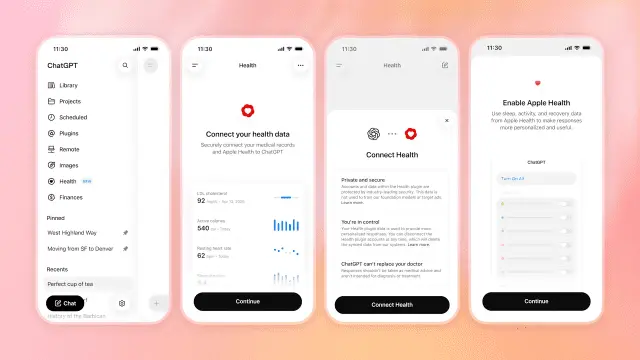
OpenAI announced that ChatGPT Health, its health-answering feature, is opening to all users aged 18 and over in the United States. The rollout covers logged-in users on every plan — Free, Go, Plus and Pro — arriving progressively on web and iOS.
What changed
During the pilot period OpenAI widened integrations with outside services including Apple Health, hospital medical records, One Medical and Function Health. Over the same stretch, weekly health-related questions grew from 230 million to 300 million.
The most practical change is the entry point. Users no longer need to visit a dedicated hub: answers grounded in connected data now surface inside ordinary conversation. The feature moved out of a separate menu and into the default flow.
Models and guardrails
OpenAI says GPT-5.5 Instant for free users and GPT-5.6 Solo for paid users improve urgent-care recognition and handling of complex questions. At the same time, following a lawsuit filed by a Florida pastor over a hospital-care recommendation, the company explicitly warned that ChatGPT does not replace clinical judgment.
The signal for marketers
The story is about health, but the signal is not category-specific.
Discovery keeps moving. Many of those 300 million weekly questions would once have been typed into a search box. When the answer resolves inside the conversation, no click happens.
Whoever gets cited is what remains. For a brand to appear in an answer grounded in personal data, its content has to exist as evidence the model finds credible. That is a content-structure problem, not an ad-budget problem.
Regulated categories start with language. OpenAI itself hardened its disclaimers after litigation. In health and finance, being cited by an AI answer and staying clear of exaggerated-claim rules are two sides of one discipline.
Where to start
If you are weighing how AI-mediated discovery changes your acquisition mix, our services overview outlines how we approach it, and you can get in touch to talk specifics.